Are Wax Amaryllis Bulbs Bad for the Environment? Here's the Honest Answer
By Vitaliy Tonenchuk, Dutch Bulbs B.V. Updated 2 November 2026.
As wax amaryllis bulbs have grown in popularity, so has a fair question: what is the environmental impact? The wax that makes them so easy to enjoy cannot be reused or composted in the usual way. Here is an honest look at what is involved, and why comparing a wax amaryllis with a bouquet is harder than it sounds.
Quick answer: Wax coatings on amaryllis are commonly paraffin, a petroleum-derived wax that is not biodegradable. That is a real trade-off. There is no simple verdict against cut flowers, because their footprint depends mostly on how they are grown, not how far they travel. We have not carried out a lifecycle assessment, so we do not claim an overall result. The spent bulb can sometimes be replanted.
What is the wax made of?
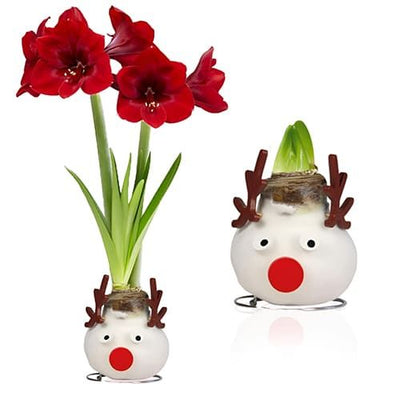
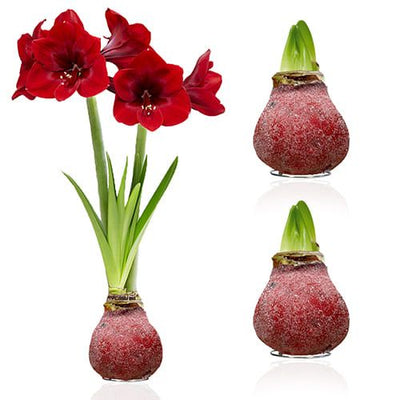
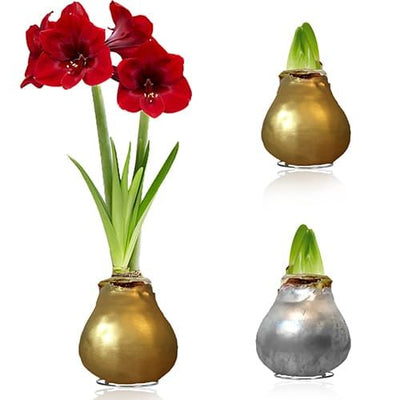
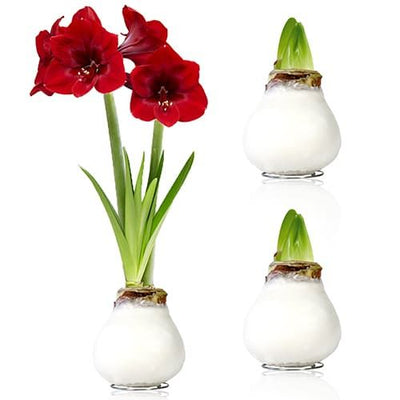
Wax coatings on amaryllis bulbs are commonly paraffin, sometimes blended with other waxes. It is applied hot, sets firm and seals in the moisture the bulb needs to flower; it also gives the colour. Paraffin is a petroleum by-product: non-toxic to handle and widely used in candles and packaging, but not biodegradable in the conventional sense.
What happens to each part afterwards?
| Part | What to do |
|---|---|
| Flower stalk and leaves | Garden compost or green waste |
| Bulb | Replant it if it is still firm, or compost it |
| Wax | General household waste: paraffin is not accepted in most kerbside recycling |
| Wax, reused | Melt it as a base for candles or firelighters |
Can the bulb be replanted?
Sometimes. Gardening writer Amy Andrychowicz of Get Busy Gardening explains that the bulb usually shrinks a little as it flowers, which loosens the wax: squeeze gently so it cracks, peel it off and plant the bulb in a pot or the garden. Another gardening writer, Nourish and Nestle, adds the honest caveat: some waxed bulbs recover and regrow, others may not have enough stored energy. Waxed bulbs have usually had their roots trimmed, so expect slow establishment and probably no flowers in the first season. Our step-by-step guide is what to do with waxed amaryllis after it blooms.

How does it compare with cut flowers?
Less simply than you might think. It is tempting to assume flowers flown in from far away are the worst option. The best-known study says otherwise: Cranfield University, in work commissioned by Sainsbury’s and World Flowers, compared roses grown in Kenya and flown to the UK with roses grown in heated, lit Dutch greenhouses, and found the Kenyan roses had about 5.8 times lower CO2 emissions even after counting the air freight. The way a flower is grown can matter more than the distance it travels.
So we cannot honestly say a wax amaryllis has a smaller footprint than a bouquet; it depends on which bouquet, from where, in which season. What we can say:
| Wax amaryllis | Cut bouquet | |
|---|---|---|
| Footprint | Not measured by us | Varies widely with growing method |
| Display life | Two to three weeks of flowers | Typically a week or two |
| Water and care | None once placed | Fresh water and recutting |
| End of life | Plant matter composts; wax does not | Composts |
| Second life | Bulb can sometimes be replanted | None |
Is it worth buying despite the trade-off?
We think that is a fair conversation. Wax amaryllis are not a zero-impact product and the paraffin coating is a genuine trade-off. Against that, the flowers last longer than a typical bouquet, need no water or upkeep, and the bulb has a second life if you pursue it. If the wax is your main concern, an unwaxed amaryllis planted in soil is the alternative: it needs a pot, compost and watering, and it can be grown on year after year. We are watching plant-based and recyclable waxes as they become available at scale.
Frequently asked questions
Is the wax toxic?
No, paraffin is safe to handle. The amaryllis plant itself is toxic to cats and dogs, so keep it out of their reach.
Can I compost a wax amaryllis?
The stalk and leaves, yes. The wax goes in household waste, or is reused as a candle base.
Which is greener, a wax amaryllis or a bouquet?
It depends on how the bouquet was grown. The Cranfield rose study shows production method can outweigh transport distance. We have not measured our own bulbs.
Keep reading
- What to do with waxed amaryllis after it blooms
- How to store amaryllis bulbs for reblooming
- Can amaryllis be grown outdoors?
Questions about how our bulbs are produced? Get in touch, or sign up for our newsletter at the bottom of this page.🎄 All amaryllis →